Namaste all over the place!
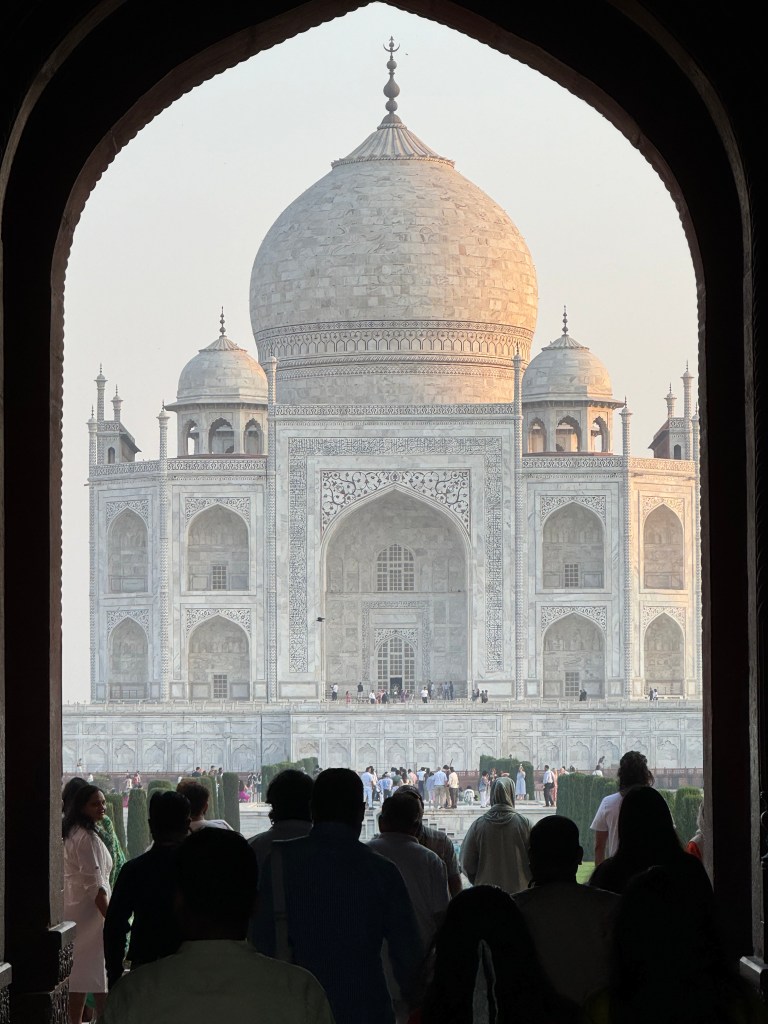
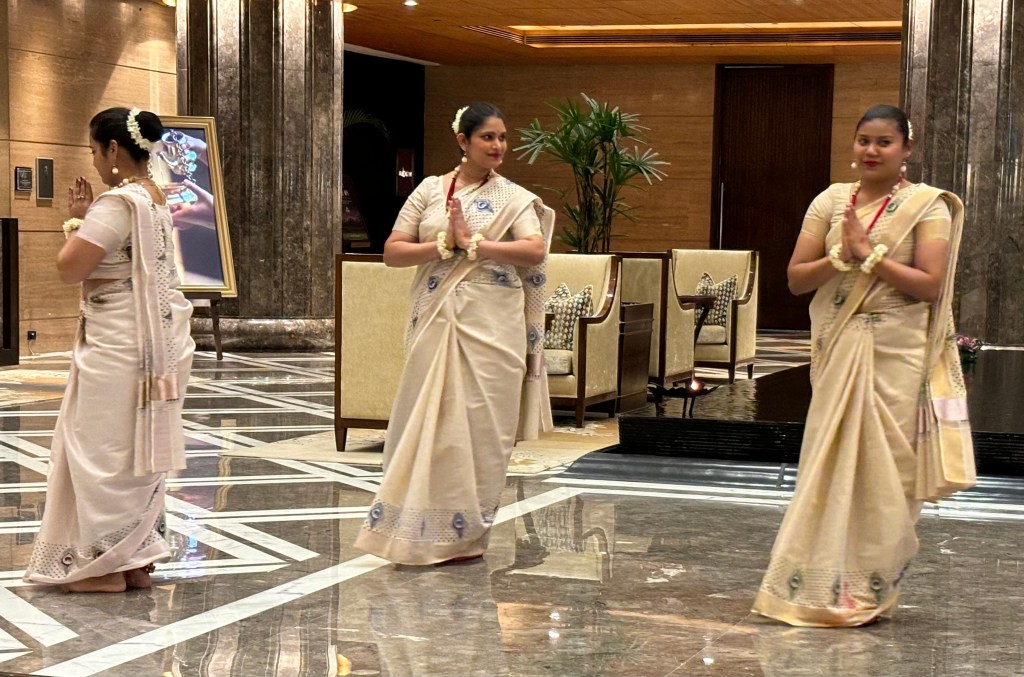
Namaste describes how hospitable the people of India are. I have tagged along, joining Andy here, while he has had a week of business at the India office of Rhodium Analytics, a company he cofounded with partners George and Sumit.
After renting apartments in Paris and Chamonix, this week of hotel living has been quite the change. We stayed at the Leela Ambience in Gurugram, the smaller city (1.3 million, similar to Dallas) adjacent to Delhi (population 32.9 million). The hospitality both at this beautiful hotel and with whomever we have engaged outside the hotel has been exceptional. Staff insist on carrying my bag, even though it has wheels. The security guard, monitoring the elevators, presses the elevator button so you don’t have to; everyone at the hotel anticipates your every need (especially if you are a man so I say c’est la vie to that 😉). For someone who doesn’t want to impose or bother anyone, I have accepted these assists so as not to insult hotel staff. Then, imagine walking through a huge hotel lobby where fifteen people greet you with “namaste” 🙏🏼 and of course, you must acknowledge their greetings with a return namaste 🙏🏼. Bonus for me is that yoga is offered at the hotels; it’s good to have a yoga practice back in my life as I did not avail myself of yoga most of my time in France 🧘 and it is so cool to practice yoga where it all began.
On Tuesday evening, Andy, George and I were invited to Sumit’s apartment for a delicious vegetarian meal, all created by Sumit’s wife, Aarushi who prepared a feast while chasing after her adorable daughter Radhya. We enjoyed many appetizers and a lovely dinner. And Sumit insisted on driving us both ways, out of his way; we could not refuse.
About the drive, George suggested that I ride in the front passenger seat to experience metropolitan Delhi’s traffic. Drivers. Mopeds. Auto rickshaws. Trucks. And constant lane-switching with a language of honking that was new to me. In fact, painted on the rear of most trucks are the words “blow horn.” Every so often, stray animals appeared along the route, packs of dogs and even small herds of large cows! In the midst of all this, one might see a lady passenger, behind her moped driver, dressed traditionally, sitting side saddle, chatting away on her cell phone, oblivious to the traffic, the noises, the cacophony.

Not a traffic light in sight — left turns across an intersection are un-choreographed chaos. And somehow this disorganized system is understood by the drivers; no one gets hurt. Fortunately, the traffic is so bad that no one can go too fast!
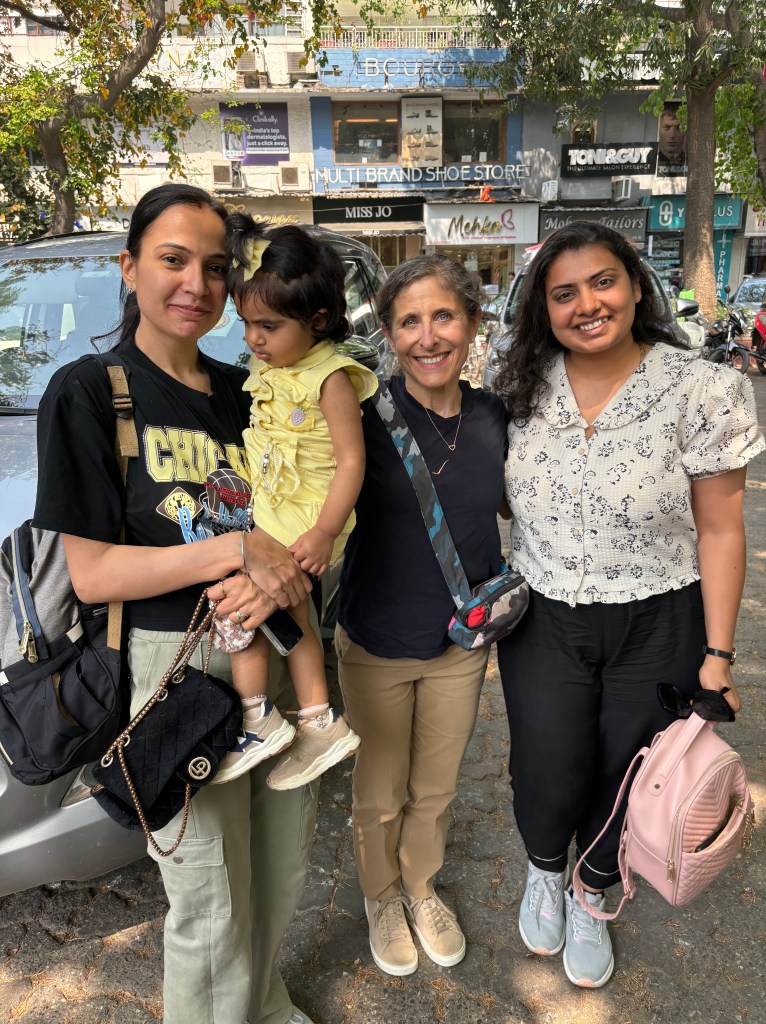
On Wednesday, I experienced another drive through New Delhi with Aarushi, Radhya and Aarushi’s friend, Vanita, when we went to the Khan Market and to lunch. It was lots of fun but I do feel for the younger moms of India. Aarushi has a background teaching chemistry and is now a stay-at-home mom. Radhya rules the roost and there are no high chairs, car seats nor strollers in which to buckle in a toddler. Moms spend a good part of their waking hours chasing the kids who run (and run away) freely and mischievously, giving moms a run for their money!
Some India background:
Modern day India includes 28 states and among them, more than 20 (some say 121) languages and over 19,500 dialects. While Hindi and English are the official languages, English is the most common denominator as geography determines the local language.
As of last June, the Republic of India was declared to be the most populous country in the world with 1.417 billion people. Religions in India include Hindu (80%), followed by Muslims (15%) and Christian (2%).
It has been nice to be a first-timer here with Westerners who know something about Indian cuisine, which is very regional and always spicy. The norm is to be vegetarian so that appears first on restaurant’s menu; if one is a meat eater (no beef in Delhi) it’s the non vegetarian menu you will peruse. And calories per 100 grams are listed on menus and buffets, which I am finding helpful 😋.
On Wednesday evening, we hired a driver to take us to Agra, home of the Taj Mahal, the most famous monument/architecture of the Mughal age of India. Since we missed the North American solar eclipse on Monday, our version of that was sunrise at the Taj Mahal. Since 1983, the Taj has been a UNESCO World Heritage Site. We arrived shortly after 6am to see the translucent marble facade of this gorgeous mausoleum glimmer with a tint of yellow. As the day goes on, the light makes the Taj seem white for the afternoon and then red as the sun sets.
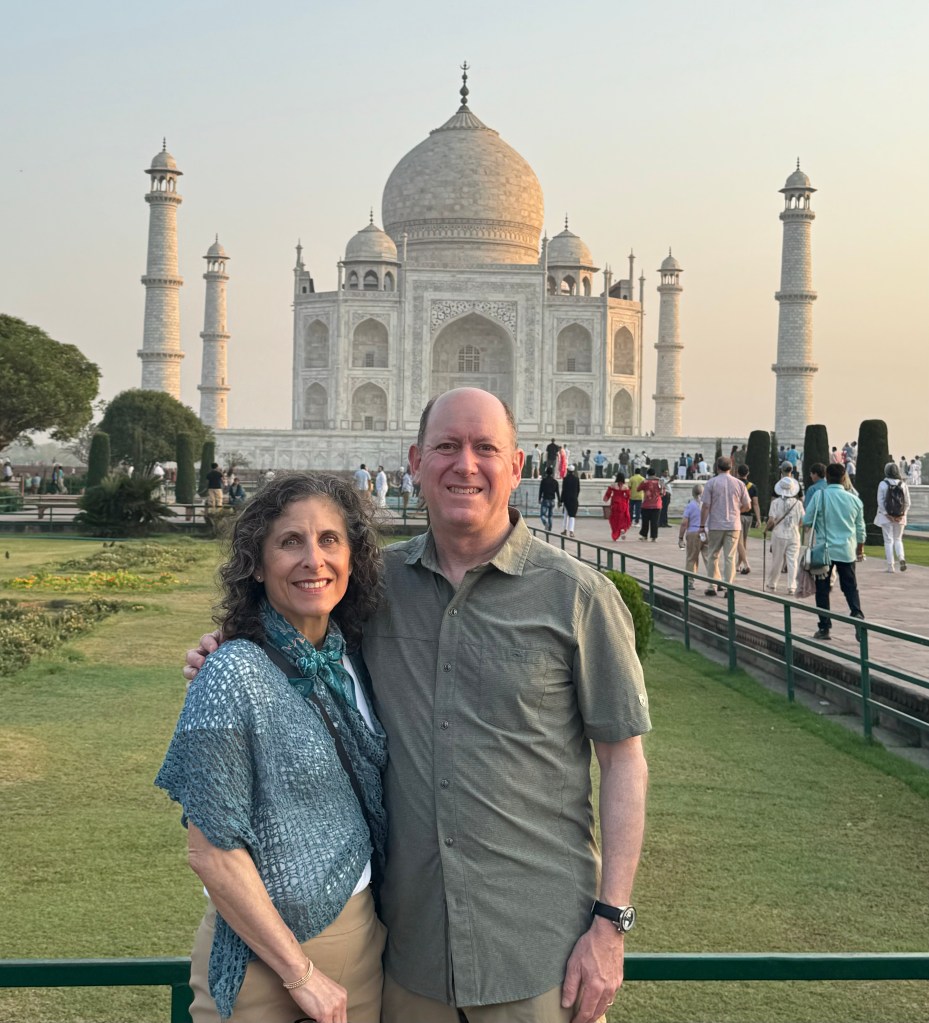

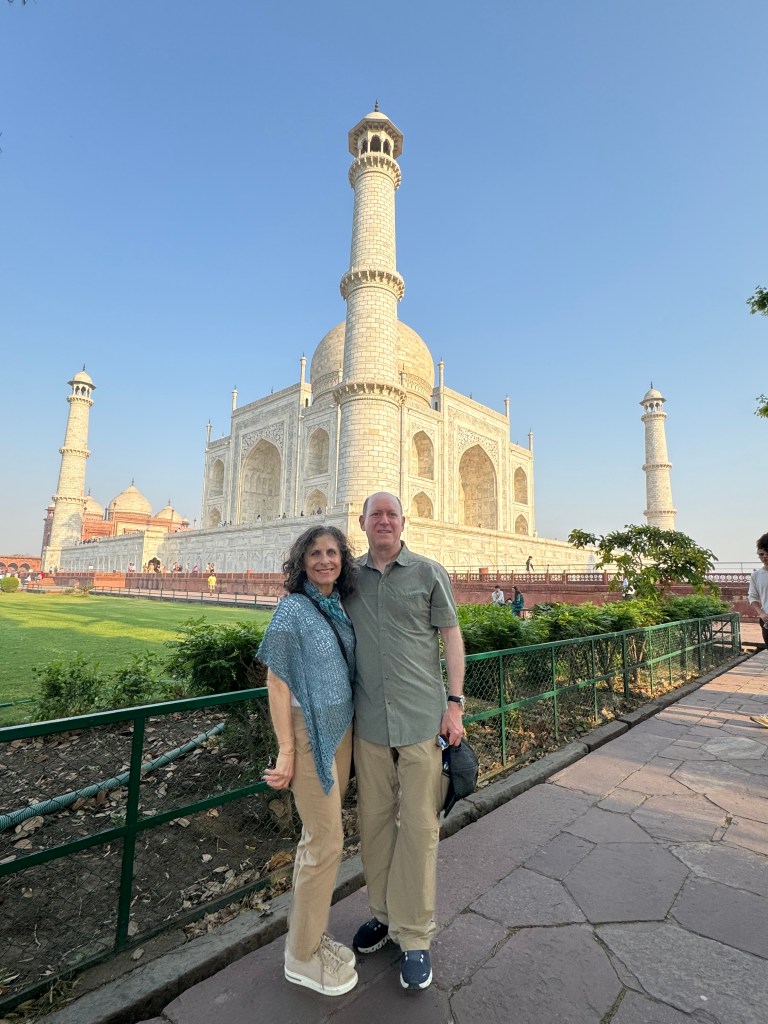
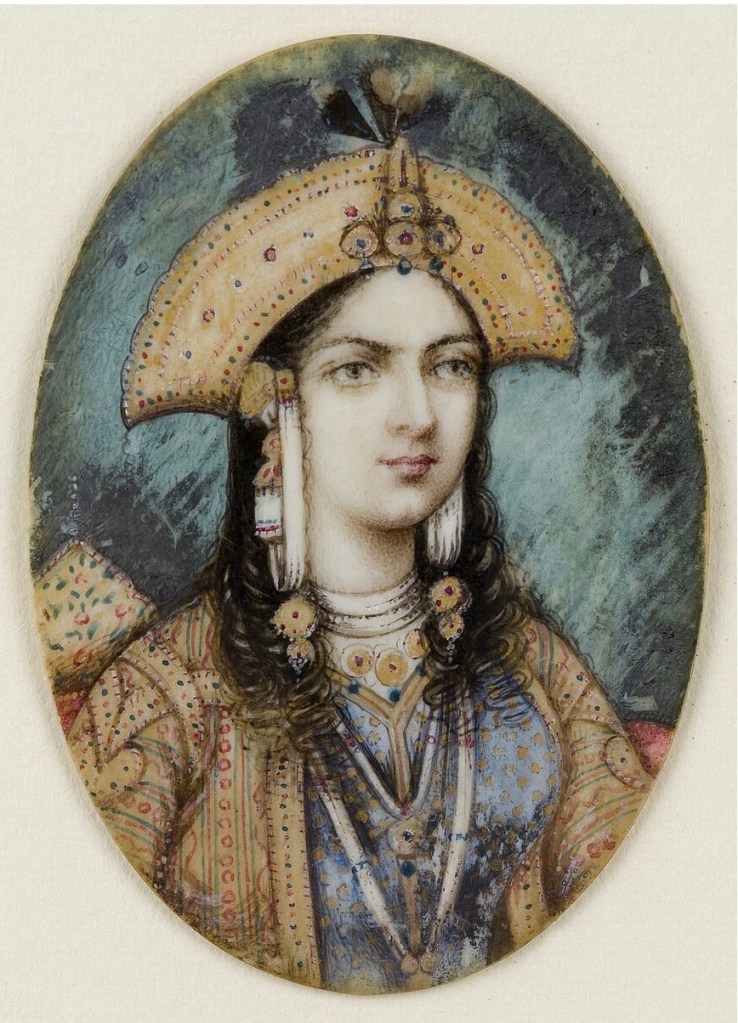
The Mughal Emperor Shah Jahan had the Taj Mahal (1631-1648) built to memorialize his beloved (third) wife, Mumtaz Mahal who died at the young age of 37, after giving birth to her 14th child (over the couple’s 19 year marriage). Shah Jahan was heartbroken and spared no cost to honor his wife’s memory. The Taj was constructed by 20,000 artisans over a 22-year period, along the bank of the Yamuna River. Its landscape includes gardens, a mosque and a jawab made of red sandstone, creating balance and harmony. The Taj Mahal, has been described as “the jewel of Muslim art in India and one of the universally admired masterpieces of the world’s heritage”
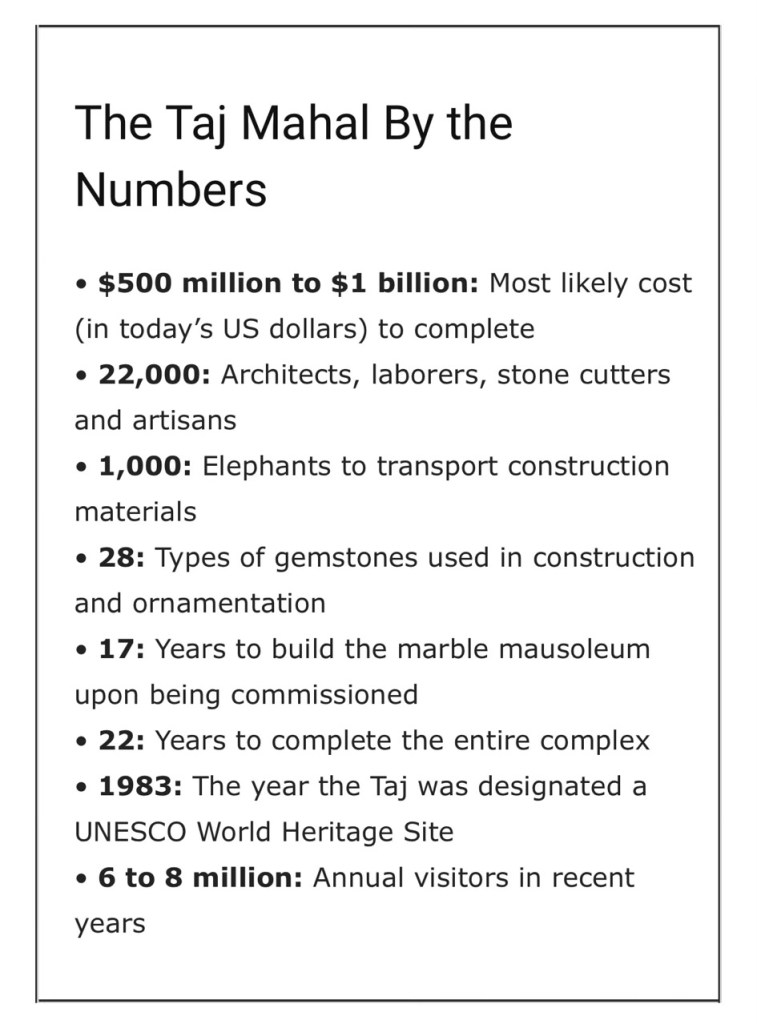
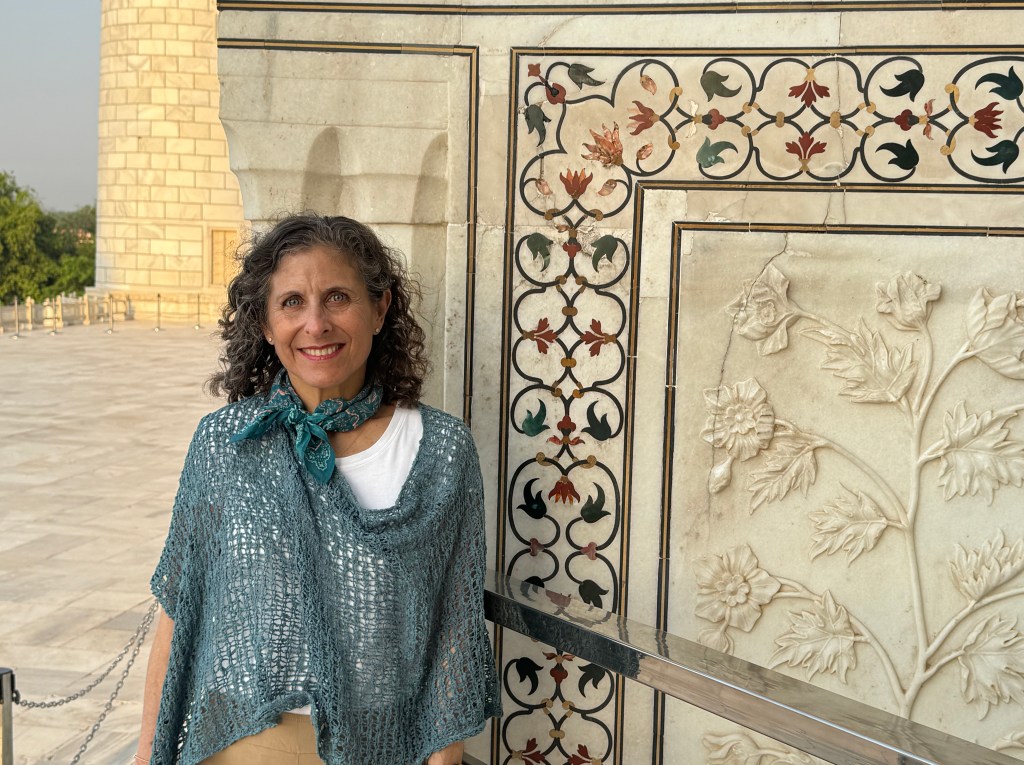
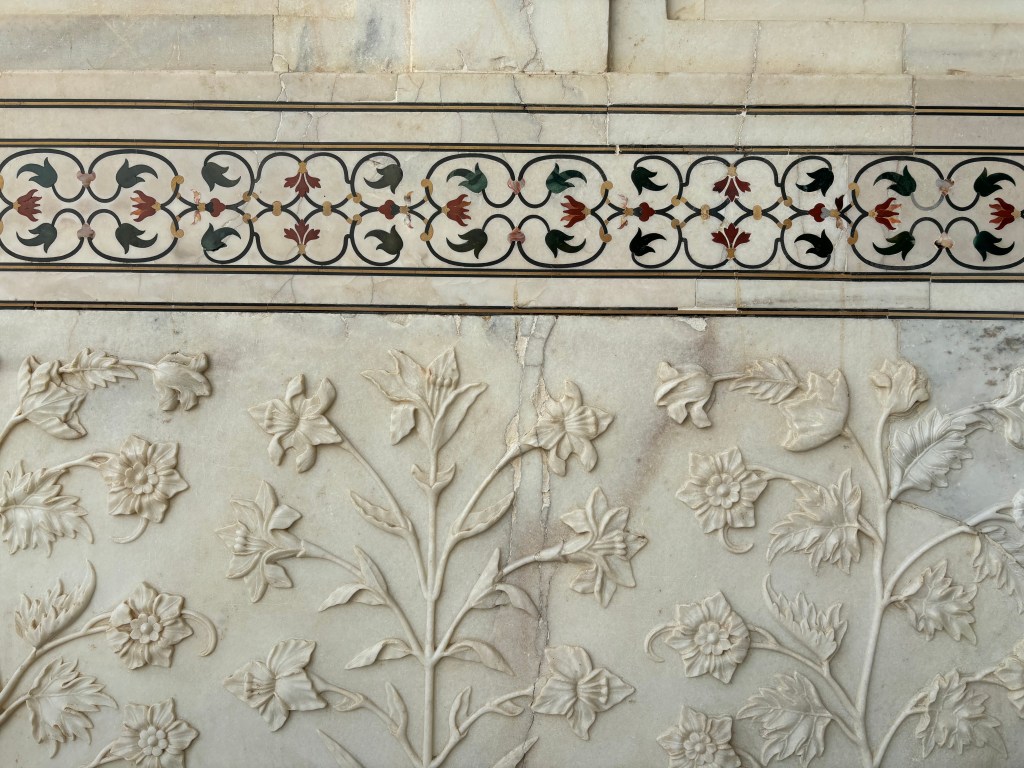
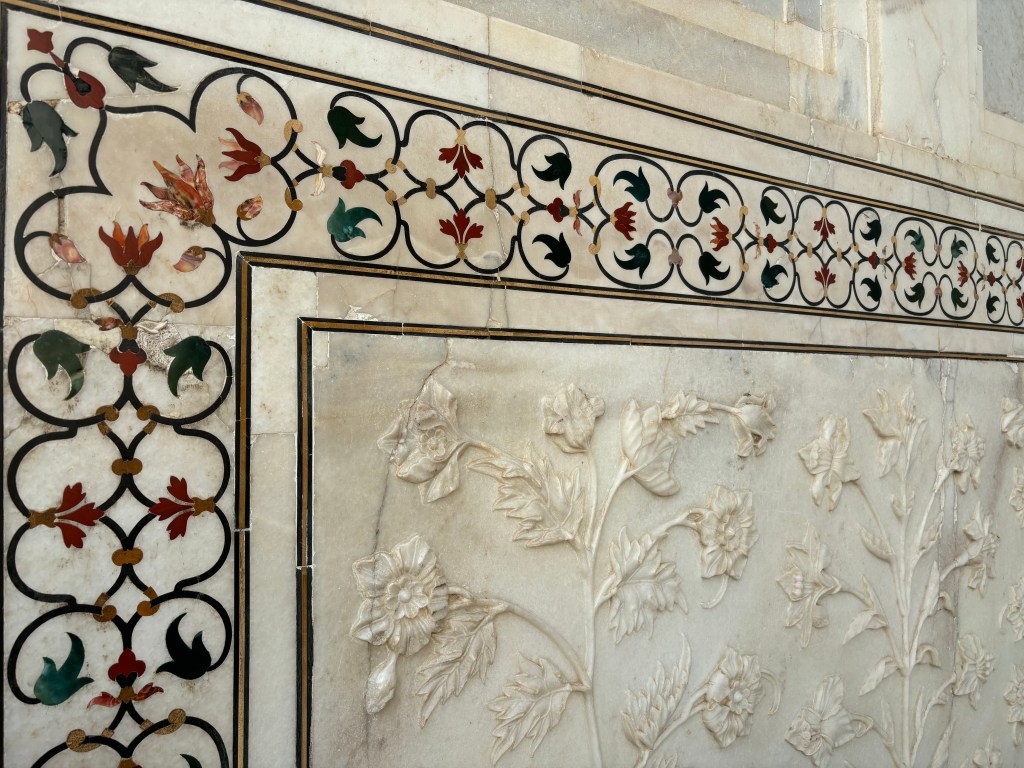
The craftsmanship throughout the Taj is extraordinary. The term for a mosaic made of “hard stone” is called pietra dura, which was used here. Its style came from Florence during the late 16th and 17th centuries. Among the colored stones most used here are jade, onyx, coral and lapis lazuli (and 24 others).
Shah Jahan was part of the second Islamic group to rule this part of India, the Mughals whose leader Baber came from Uzbekistan and invaded in 1526. Since the Mughals did not have a system of primogeniture, it was not uncommon for sons of the emperor to fight (and kill) for the chance to succeed their father. In the case of Emperor Shah Jahan, his victorious son, Aurangzeb overthrew and imprisoned his father, killed his brother and became the next emperor.
The Muslim festival of Eid-al-Fitr, was celebrated on Thursday, our morning at the Taj Mahal. It is the culmination of the fasting month of Ramzan, a month of spiritual reflection. Since there is a mosque on the grounds of the Taj Mahal, we entered the area with many men and boys en route to pray. Some were dressed from head-to-toe in white; others in bright colors, often decorated with sparkly bead work. We could hear the chanting of prayers throughout our visit.
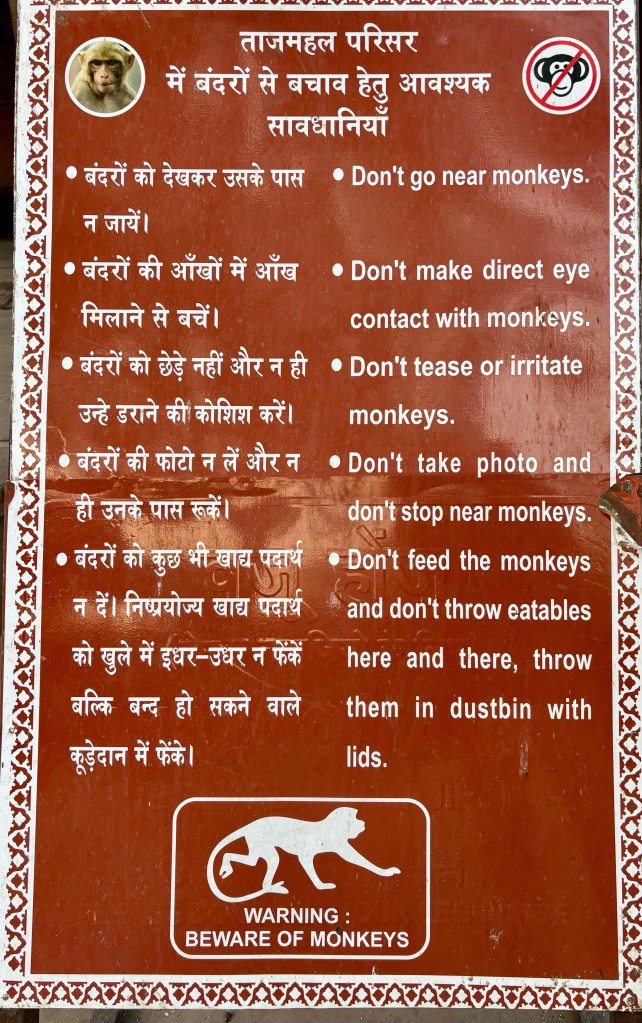
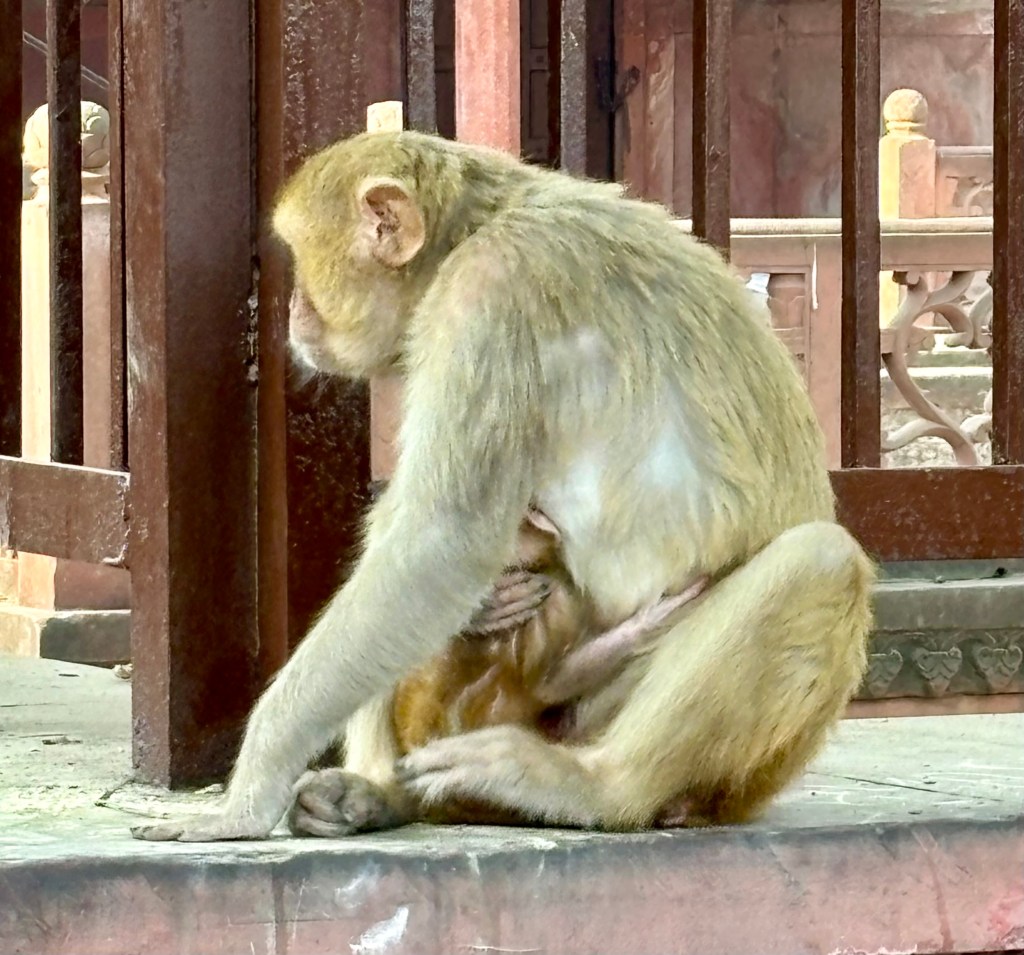
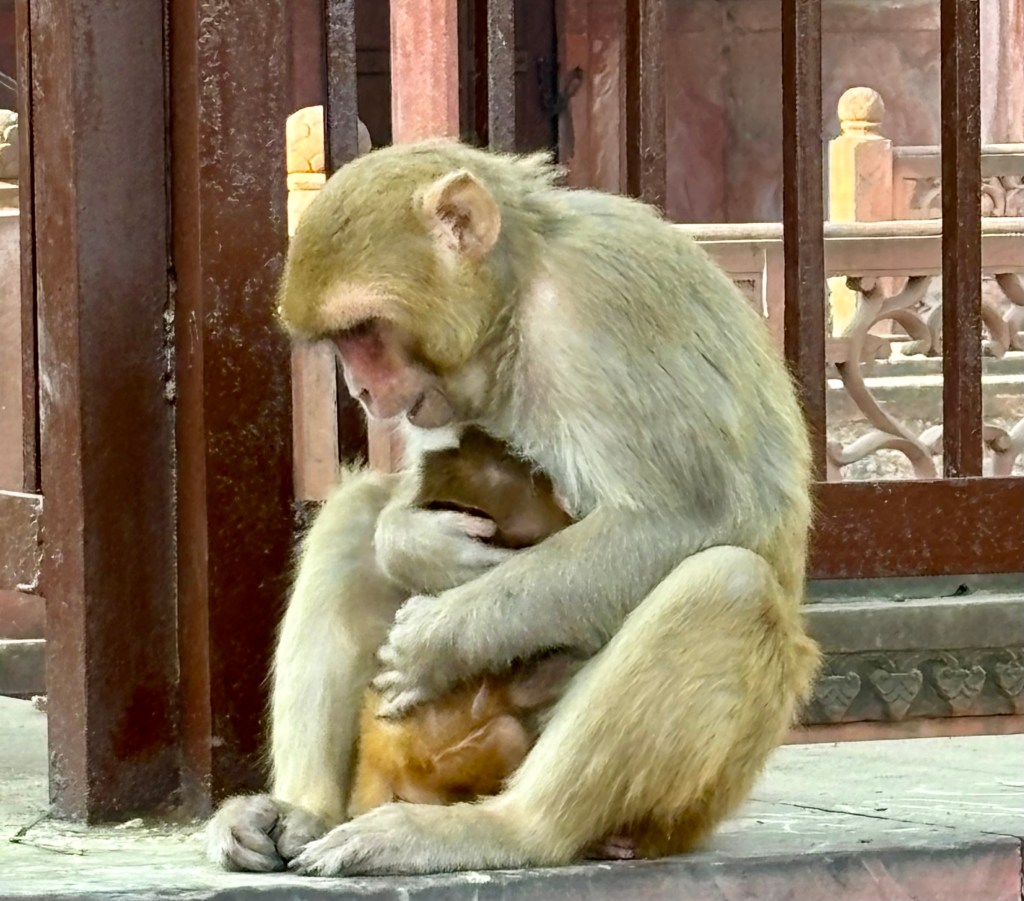
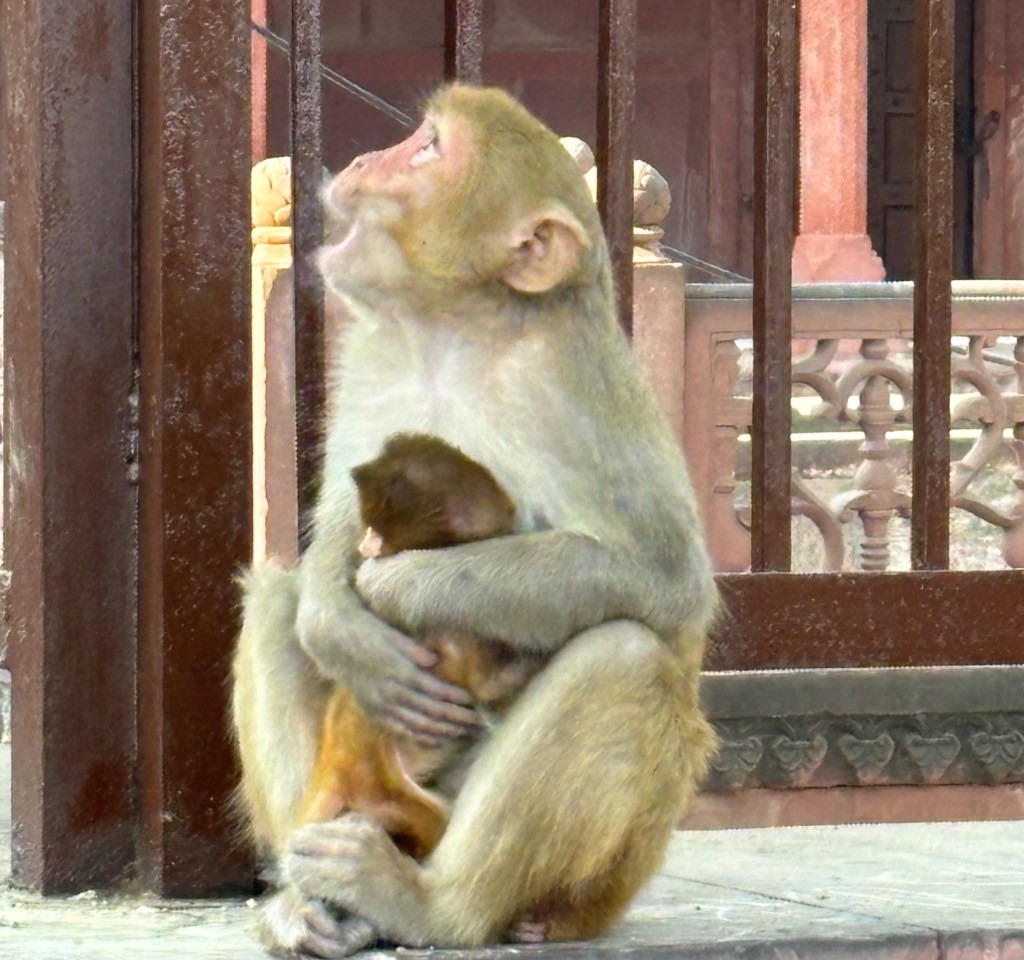
Rhesus Monkeys were all over the place. They are fun to watch but an annoyance. Watching the monkey brought back memories of that monkey in Caps for Sale, one of my favorite children’s books.
We left the Taj Mahal as the busloads began to arrive, and returned to our lovely hotel, the ITC Mughal for breakfast. About these hotel breakfasts, they satisfy any diet and any cuisine. Breakfast buffets include American, European, Asian, Middle Eastern and of course, Indian offerings so yes, one can enjoy a very spicy breakfast!
No guided tour would be the same without a visit to a local merchant to learn (and hopefully purchase) a special souvenir. Before leaving Agra, we were ushered into a marble workshop where those with the same skills as the Taj Mahal artisans are still found today. Would we like a table top of marble with pietra dura inlay work? A chess set perhaps, a round marble decoration for a kitchen table (it can be used as a lazy Susan)? We politely declined and thanked our guide and the merchant who tried his best. Back to Gurugram we went. Namaste🙏🏼.
You may be familiar with the expression Namaste as it is associated with both Hinduism and yoga. The word comes from Sanskrit and literally means “bowing to you” or “I bow to you,” and is used as a greeting. I consider it the hakuna matata (in Swahili, roughly translating to “there are no troubles”) of India.
Namaste!
 The Innocents Abroad, 21st Century Version